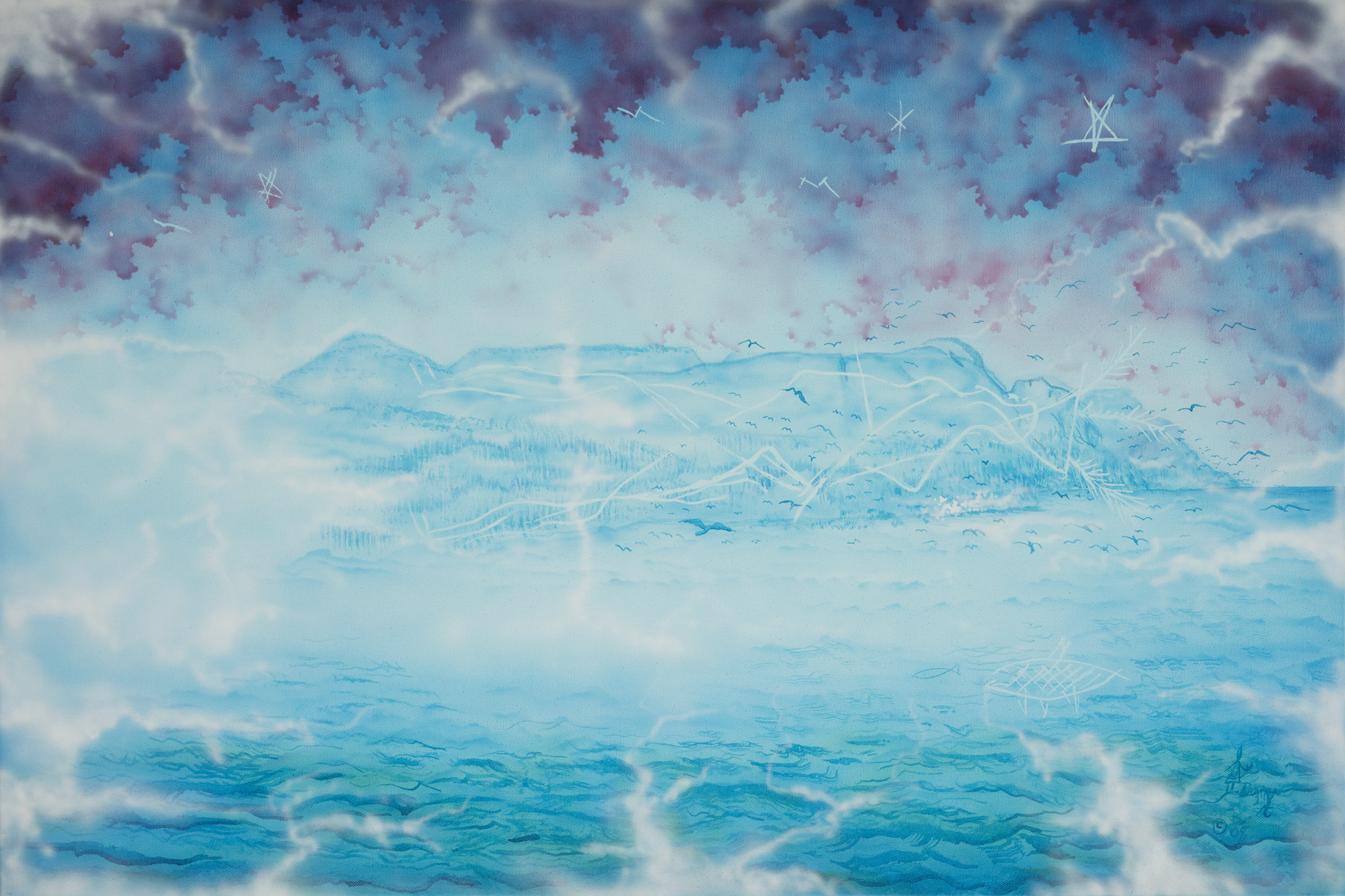
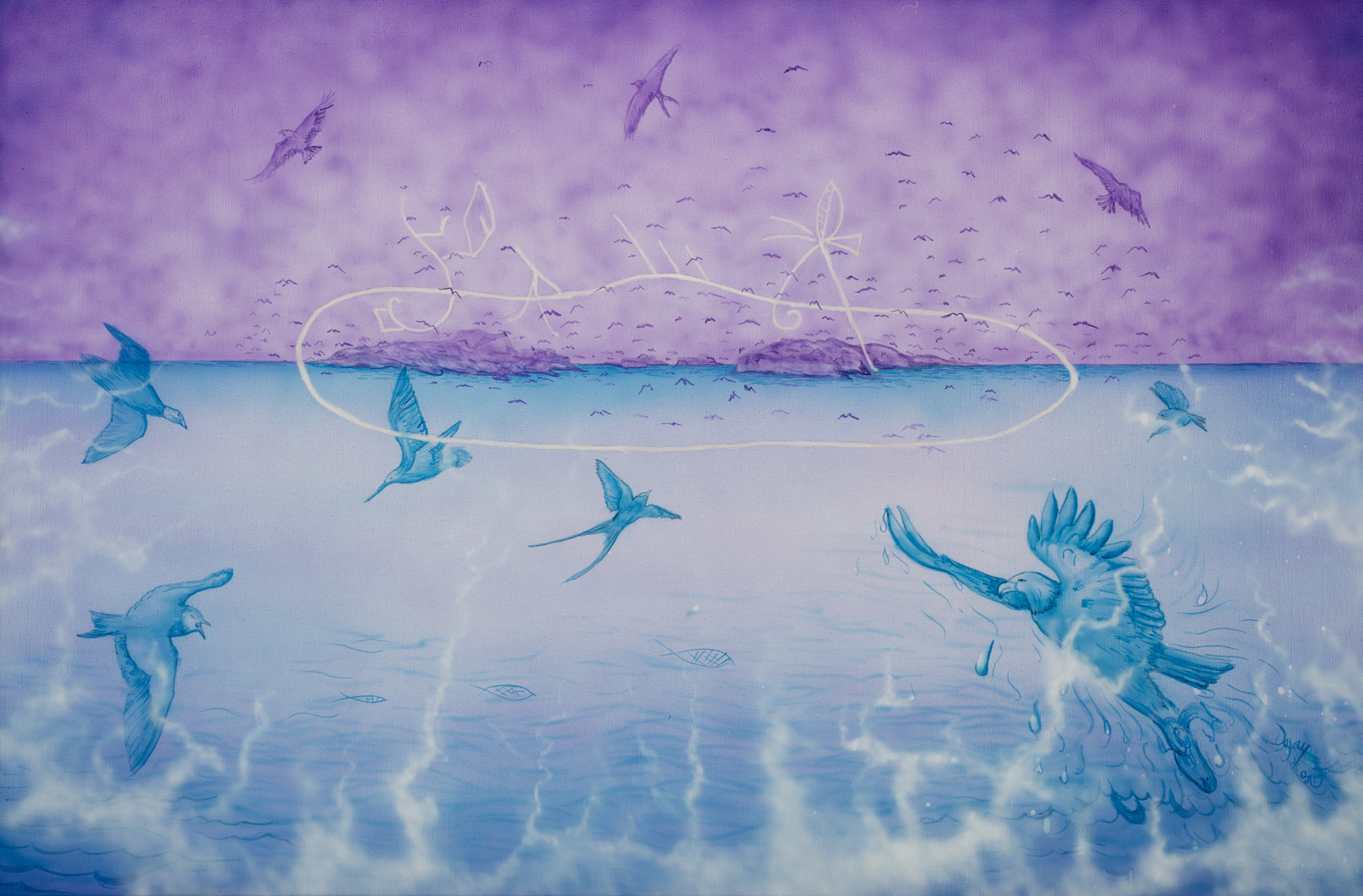
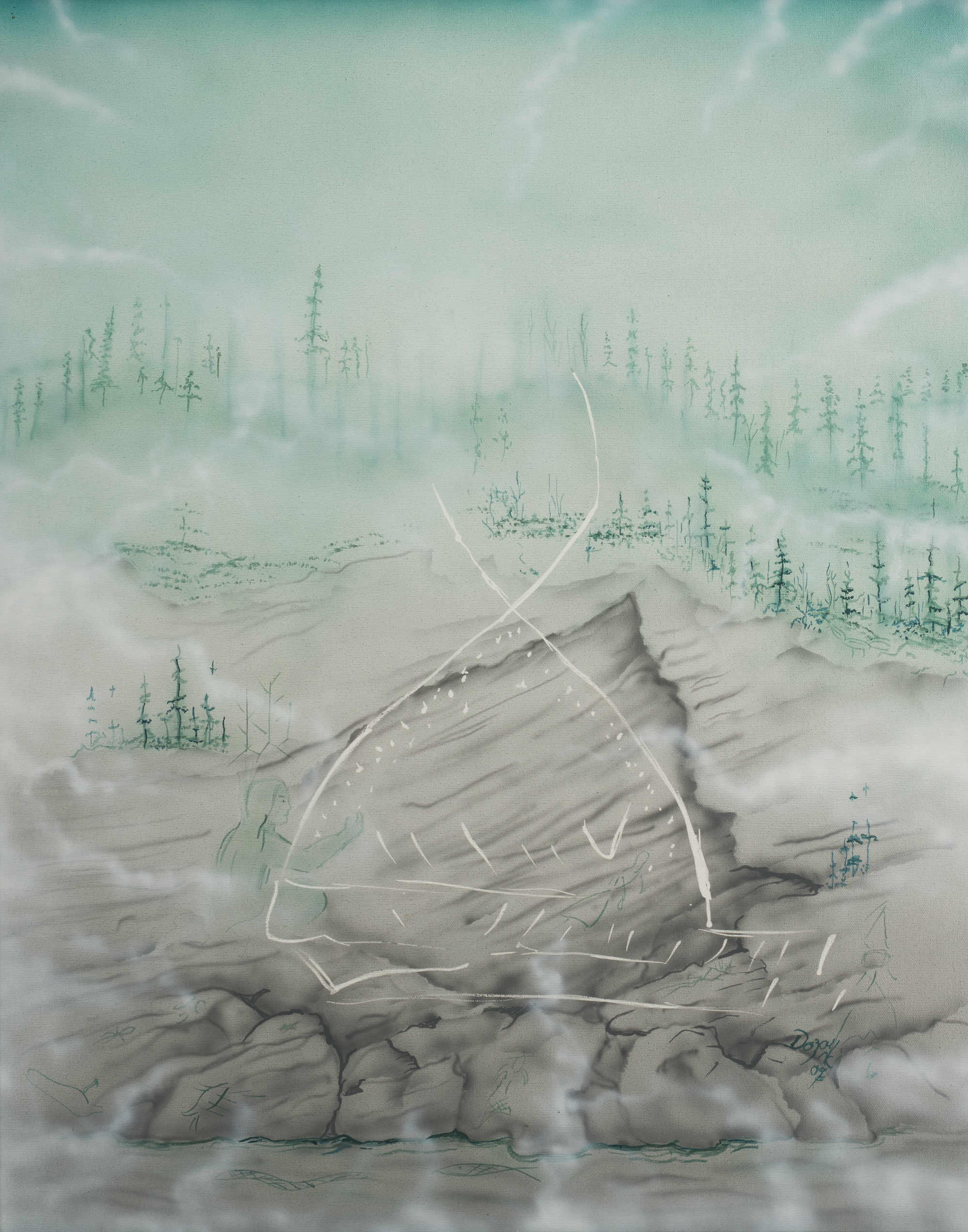
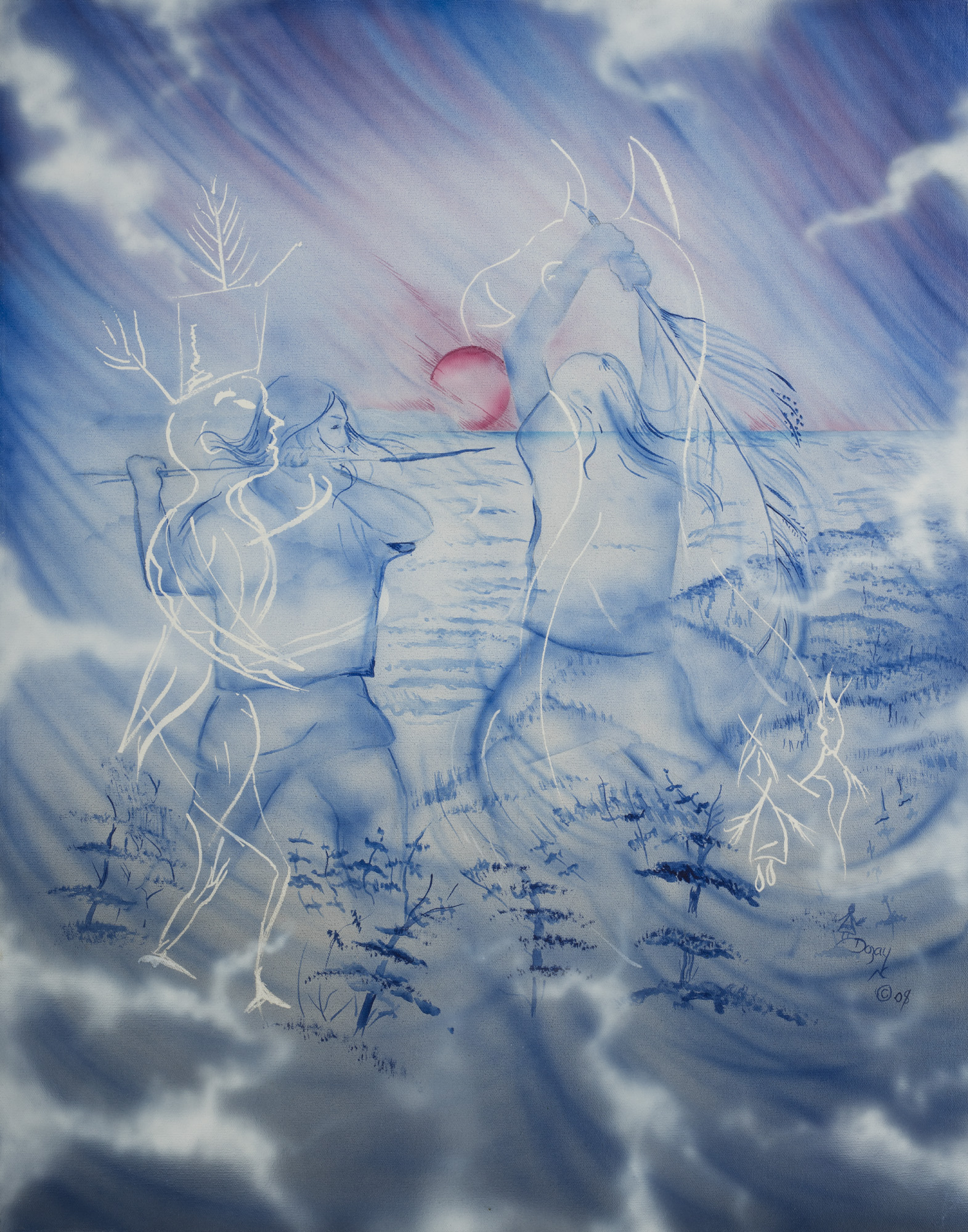
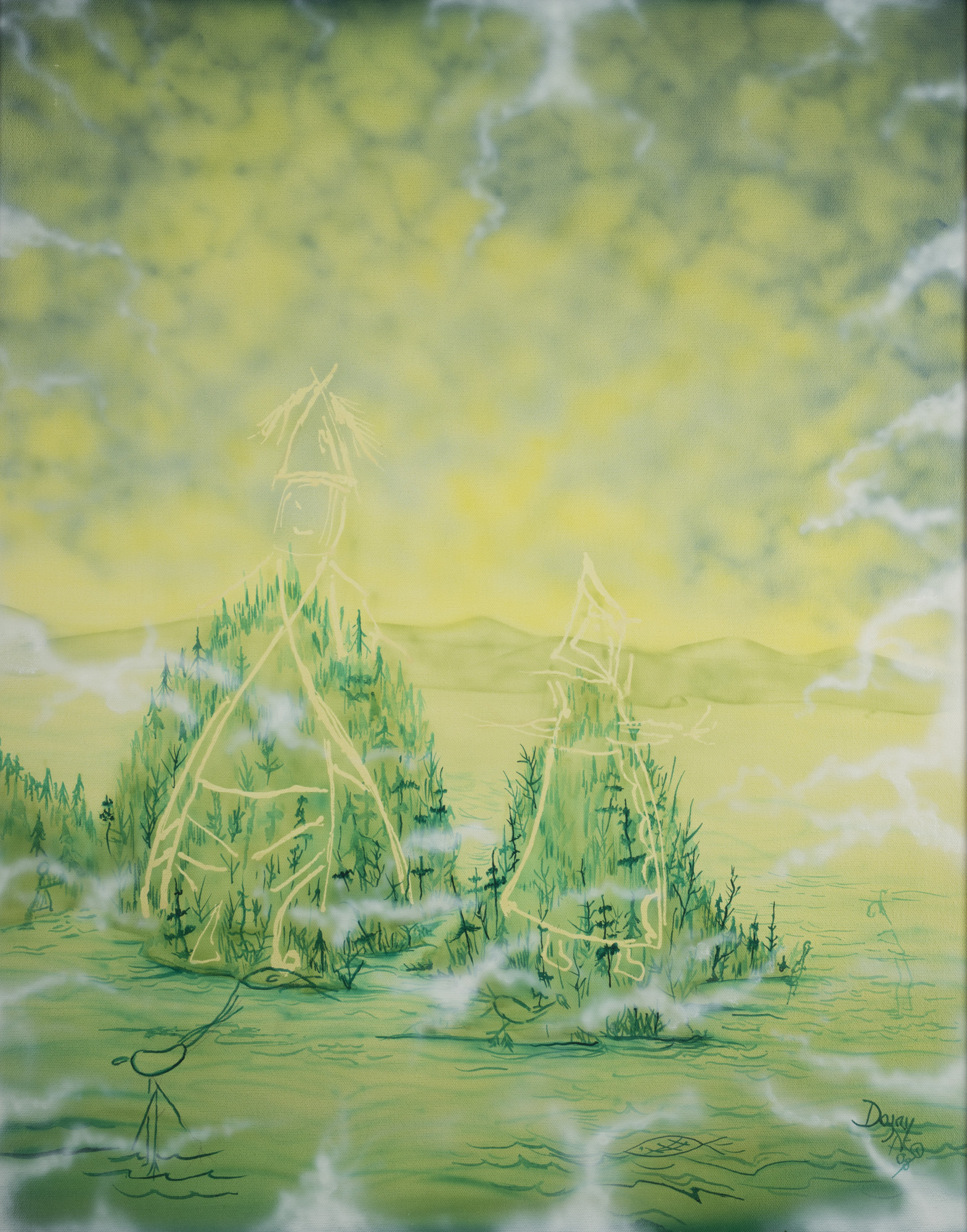
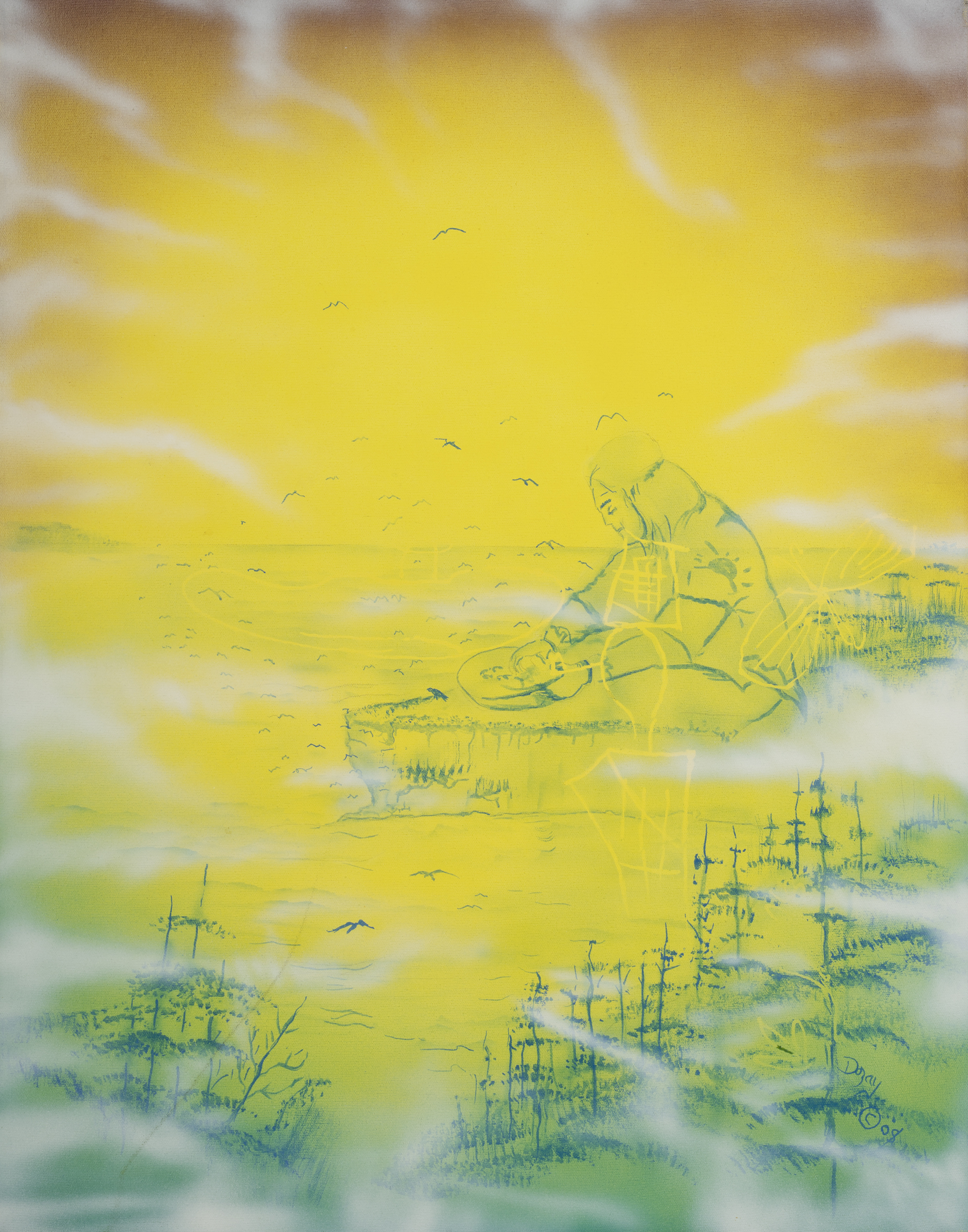
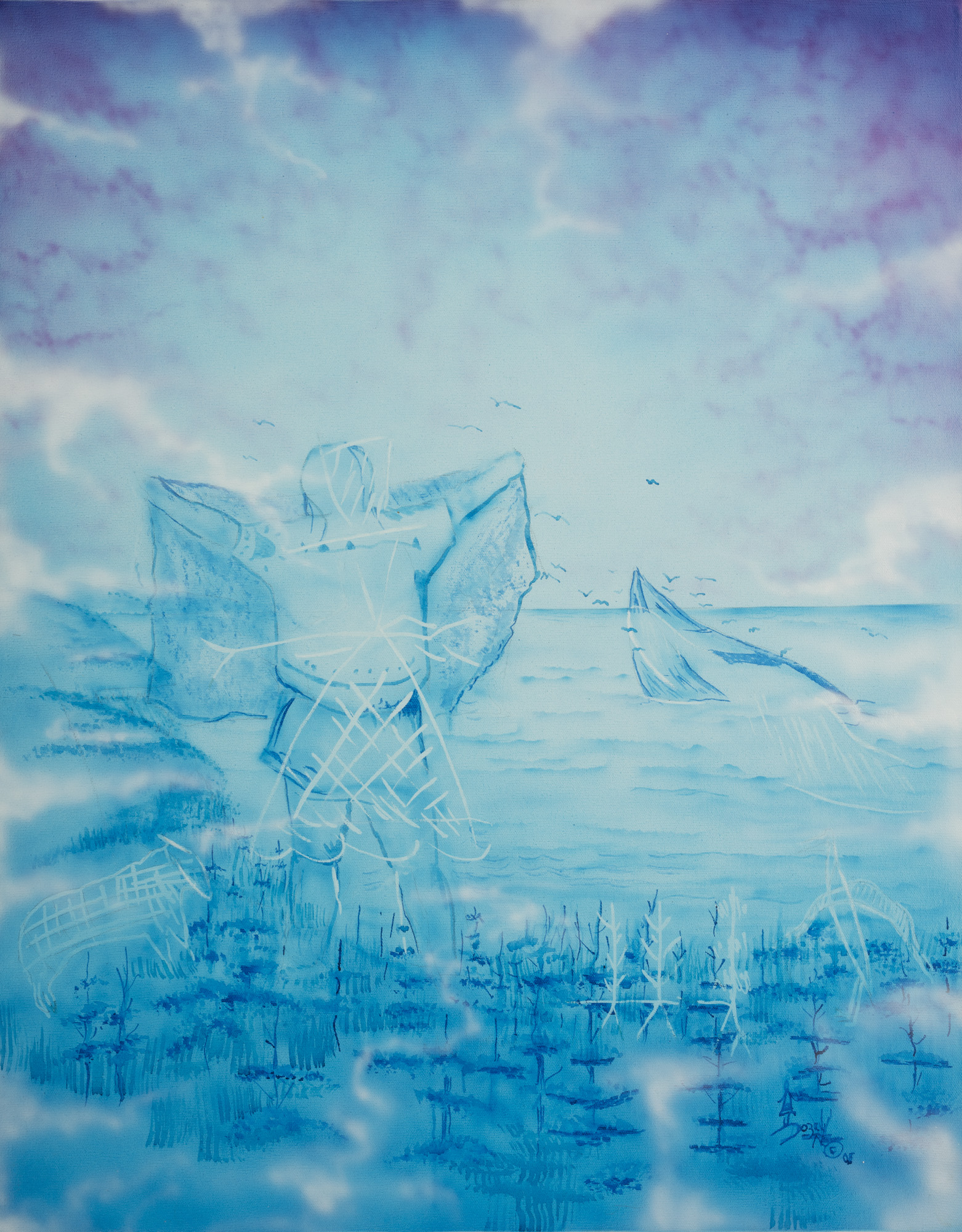
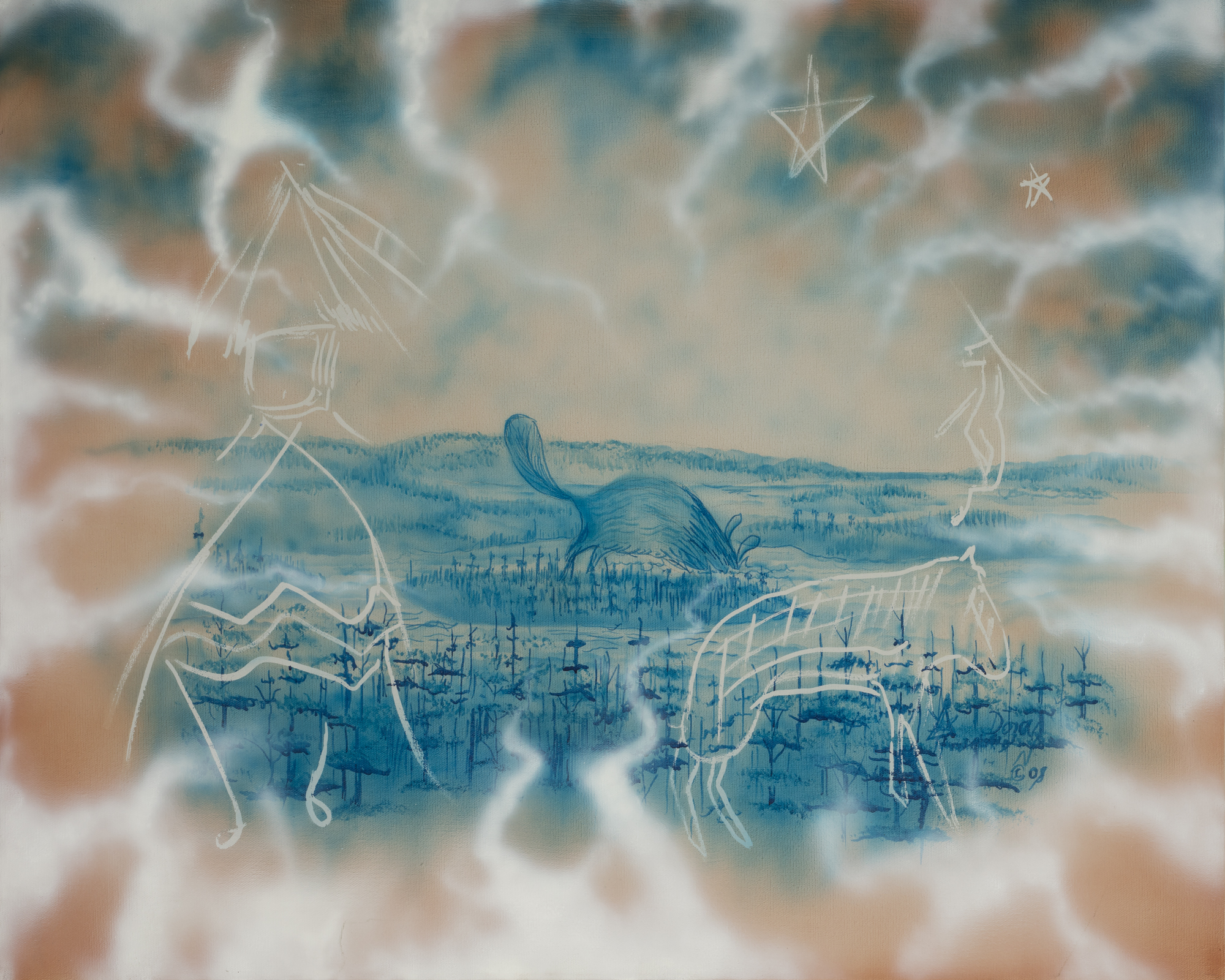
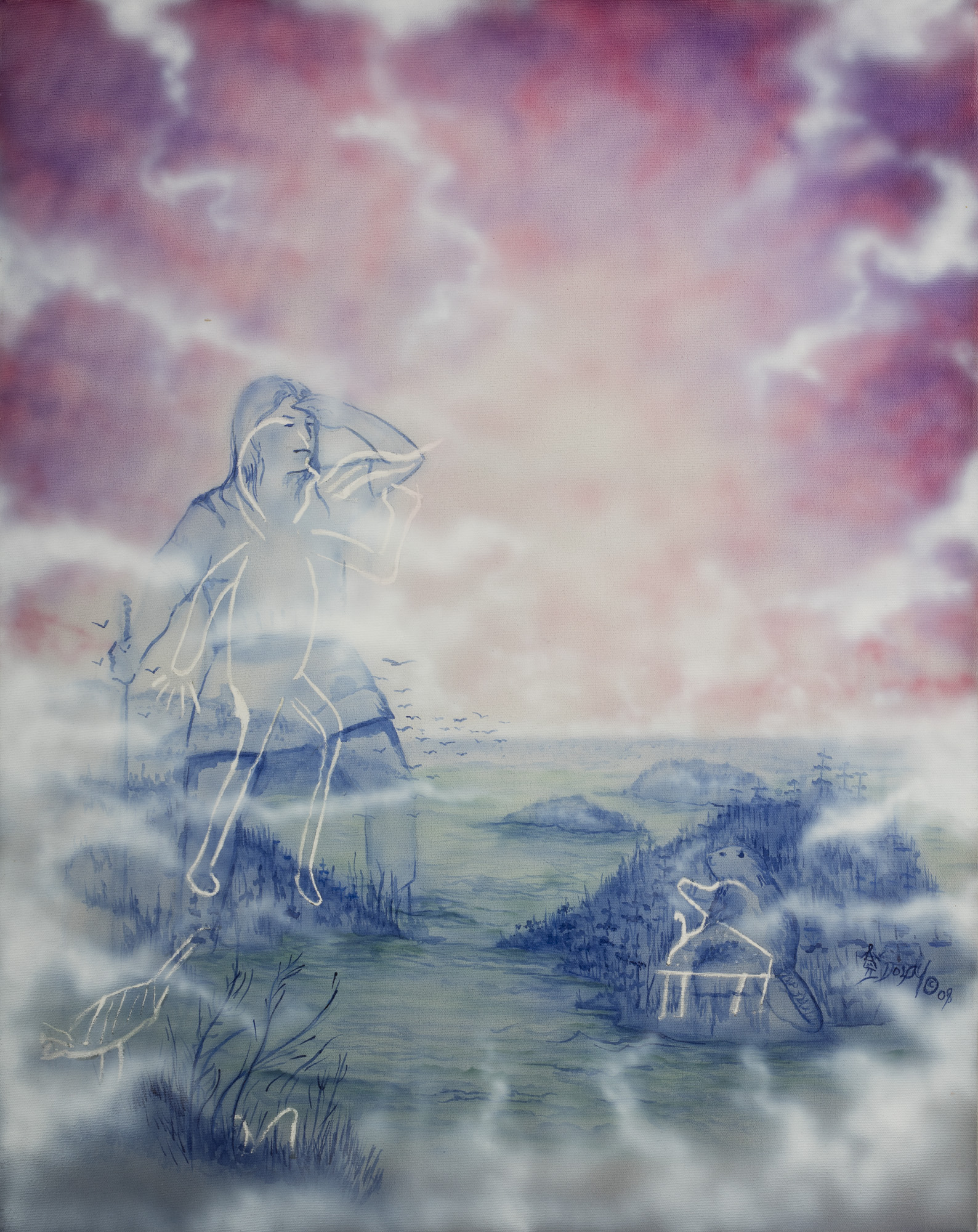
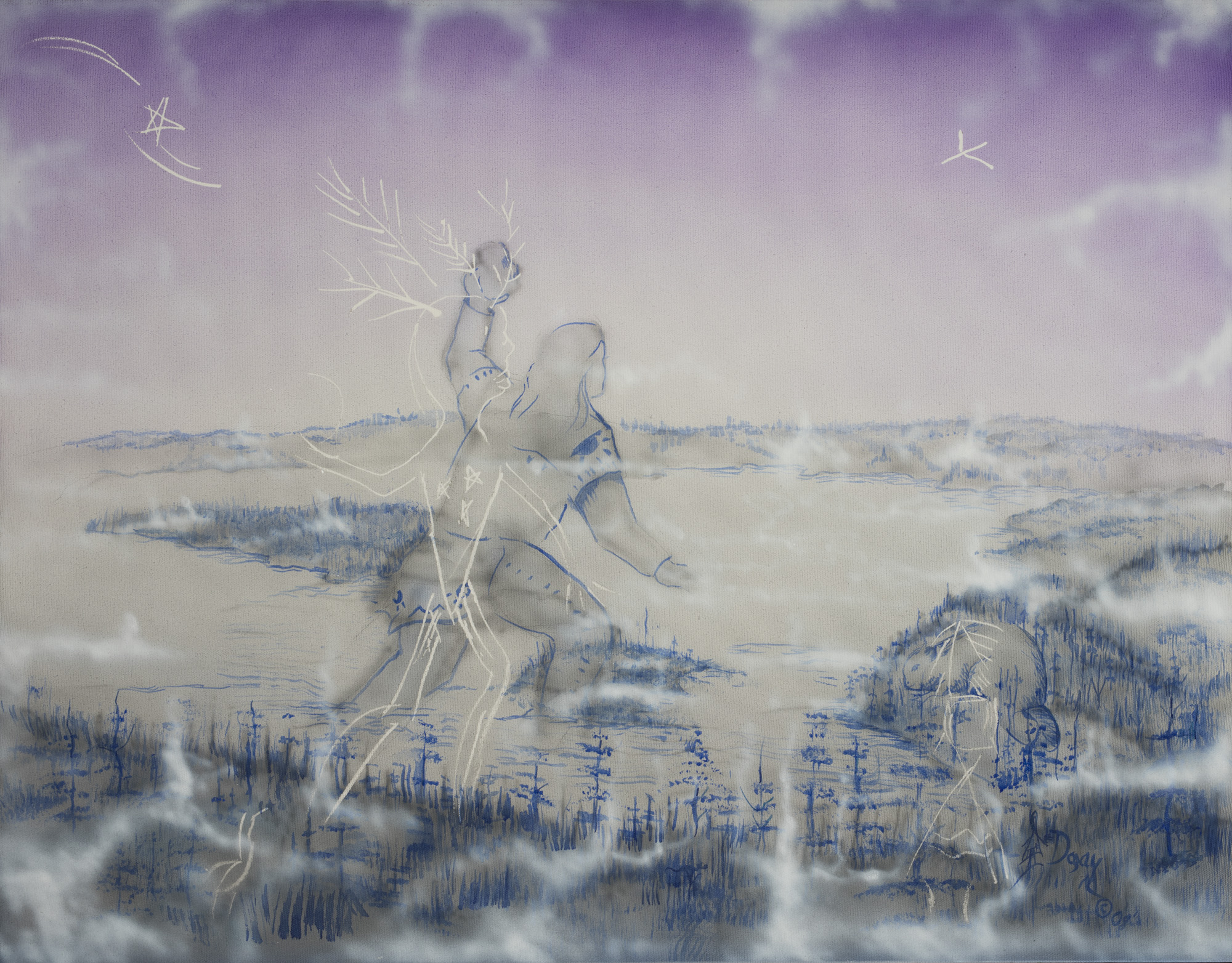
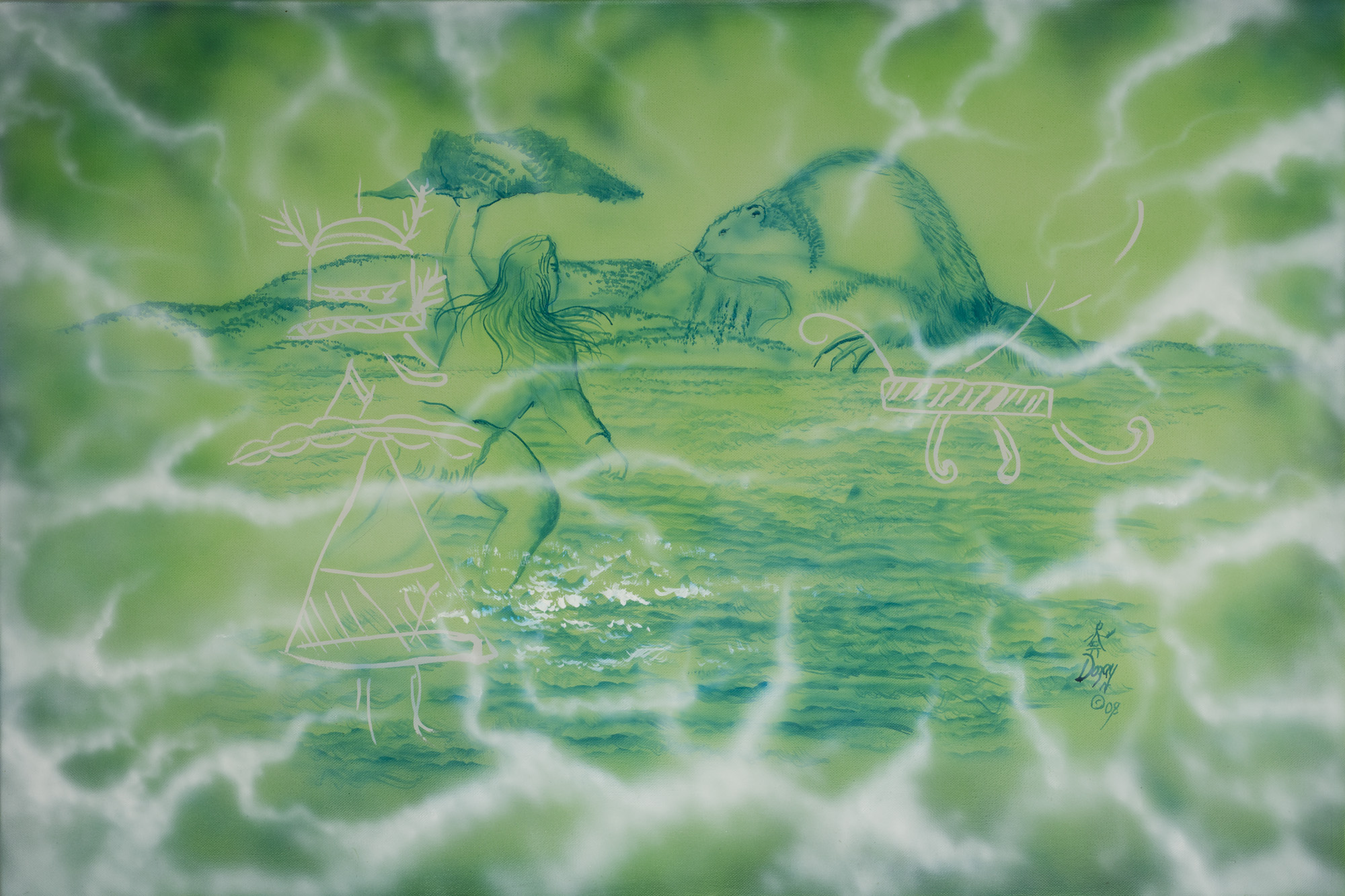
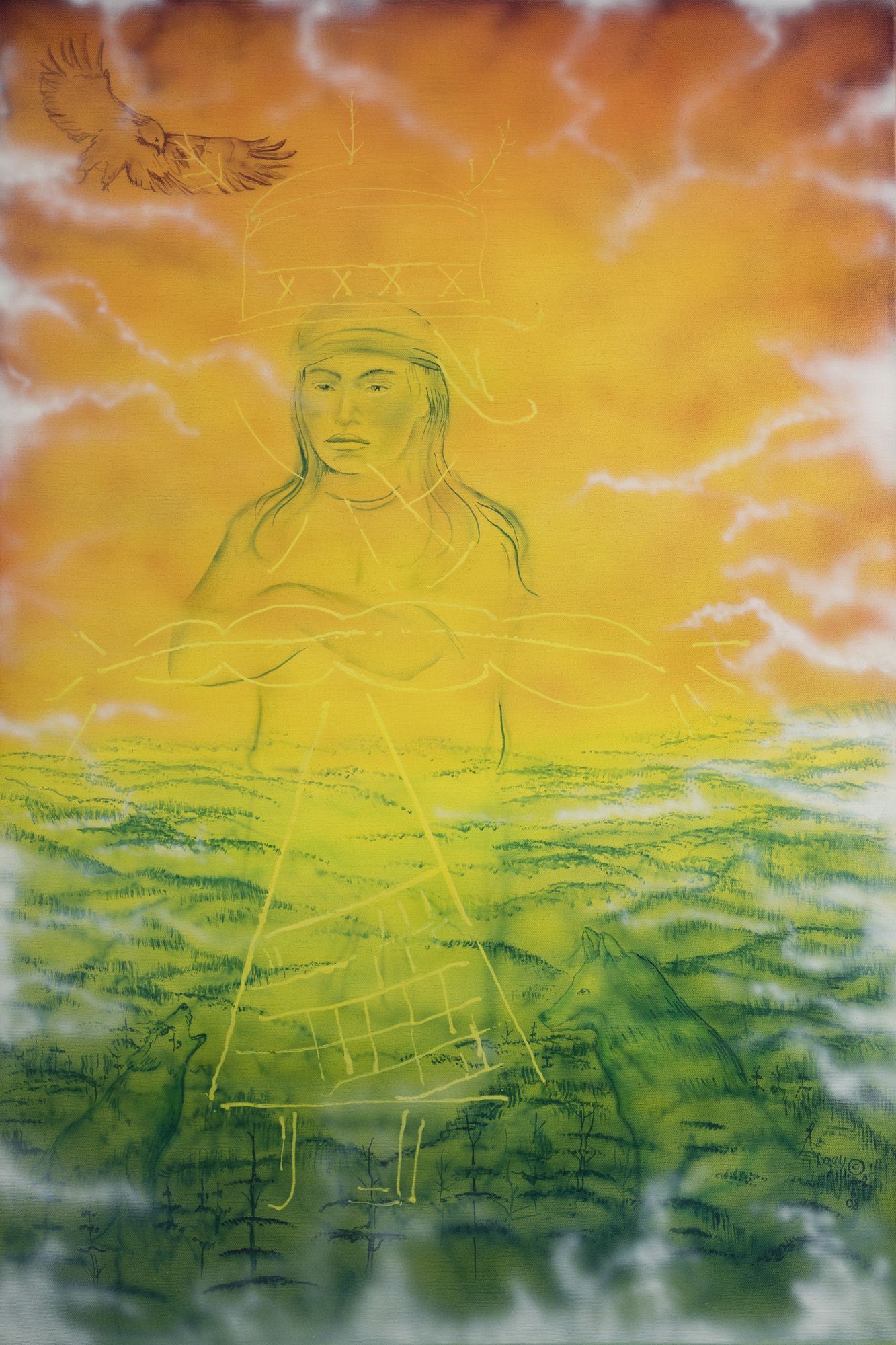
The Unama’ki Series, created earlier in Dozay’s career, focuses on the Mi’kmaq stories and landmarks of Cape Breton Island. These works interweave Kluskap’s teachings with the distinctive geography of Unama’ki and Mi’kmaw petroglyph designs — from the Fairy Hole of St. Ann’s Bay to the Bird Islands, Cape North (Wreck Cove), Plaster Cove, and the Bras d’Or Lakes.
Dozay spent years researching and photographing these locations, often hiking, boating, or climbing cliffs to see them as they appear in legend. The series pairs Mi’kmaw petroglyph motifs with Dozay’s evolving artistic style, illuminating a cultural landscape where stories remain etched in stone and shore.
How Niscaminou Made Kluskap
Kluskap was created on the bold cliffs of Cape North from the red earth, shaped and given breath by Niscaminou. He waited there through long seasons — summers, winters, wind, and rain — until companions were made for him. First came Grandmother, formed from the dew, and then Little Martin from the sea foam at the foot of the cliffs. Kluskap eventually left Cape North and made his home at Fairy Hole on St. Ann’s Bay, where he lived for many winters.
Kluskap’s Canoe, Bird Islands
When Kluskap lived at Fairy Hole, an evil wizard grew jealous of him and tried to harm two girls to spite him. The wizard forced the girls into Glooscap’s great stone canoe and pushed it into deep water, taunting Glooscap as he did so. Glooscap appeared, rescued the girls, and defeated the wizard. He then ripped apart the canoe’s shattered gunwales, leaving them as two islands that later became known as the Bird Islands, where seabirds still nest.
Kluskap’s Door
A cliff opening at Cape Dolphin is said to be the doorway to Kluskap’s domain. Hunters would leave dry punk and fish outside on a flat stone, believed to be his table, as offerings for luck and goodness. The legend teaches that people may leave gifts at the entrance but must never enter the doorway. This powerful location held deep meaning, especially as Dozay noted the difficulty and danger of accessing it for her research.
Kluskap and His Brother Malsum
Kluskap and his brother Malsum came from the Sky in a stone canoe, each possessing great power, though Malsum carried jealousy and evil intentions. Their conflict grew as Malsum plotted to kill Kluskap, even creating the creature Lox to stir trouble among the animals. Both giants shared life secrets, but Lox revealed Kluskap’s vulnerability to Malsum. In a great battle that shook the earth, Kluskap defeated his brother by striking him with a fern root, the only thing that could end his life.
Tale of the Two Sisters: Plaster Cove
At Plaster Cove, two sisters saw Kluskap’s broken canoe and laughed, mocking him for its condition. Kluskap turned them into stone as a result, fixing them forever in the landscape. These rock formations are said to be the remains of the two girls who ridiculed him. Dozay explains that reaching the site required climbing steep, unstable gypsum mounds that crumbled underfoot.
Kluskap’s Dinner at Table Head
After leaving his canoe, Kluskap traveled to Table Head on the south side of the Great Bras d’Or Lake. There he had his dinner on a flat, cliffside area. The landmark remains visible today as a clear plateau on the cliffs. It stands as a reminder of Kluskap’s presence in the Unama’ki landscape.
Wreck Cove, Kluskap Tipping His Canoe
At Wreck Cove, Kluskap’s canoe foundered, forcing him to jump out and lift his moose-skin canoe mat to dry. The large mat was left spread across the land, creating a fifteen-acre patch of bare ground still identifiable today. This landmark lies along the Cabot Trail near Ingonish. Dozay notes its enduring connection to the story of Kluskaps travels.
Beaver Series: Salt Mountain & Indian Island
Kluskap chased a beaver from Salt Mountain (Wisikk) as it tried to escape by digging through Indian Island, L’nui-mniku. The beaver passed beneath the island and surfaced at Grand Narrows after traveling through Elguanik. This painting depicts one of many beaver chases that shaped the geography of the Bras d’Or Lake region. Dozay emphasizes how frequently these beaver stories appear in Unama’ki lore.
Beaver Series: Looking for the Beaver Who Is Hiding
As Kluskap journeyed westward through the Bras d’Or Lakes, he startled a beaver at Indian Island and drove it out. He then followed the beaver through St. Patrick’s Channel, where he eventually lost sight of it. The small islands in this area are close to the modern communities of Waycobah and Wagmatcook. Dozay highlights the ties between these traditional stories and present-day Mi’kmaw communities.
Beaver Series: Throwing Stones at the Beaver
The rocks Kluskap hurled at the beaver became visible landmarks such as Little Island and Red Islands (Kwesawek). One rock was made from soil taken from Salt Mountain, while another was a stone thrown directly toward where he believed the beaver was hiding. The formation of these islands reflects the scale of Kluskaps actions and strength.
Beaver Series: Kluskap at the Canso Causeway
Kluskap attempted to stop the beaver from damaging the waters of Cape Breton, chasing it from the Canso entrance. He threw huge boulders at the beaver, forming natural features such as Porcupine Mountain. His battles created many of the smaller islands throughout the Bras d’Or Lake system. According to the legend, Kluskap eventually reduced the beaver from giant size to the small animal known today.
Kluskap Leaving the People
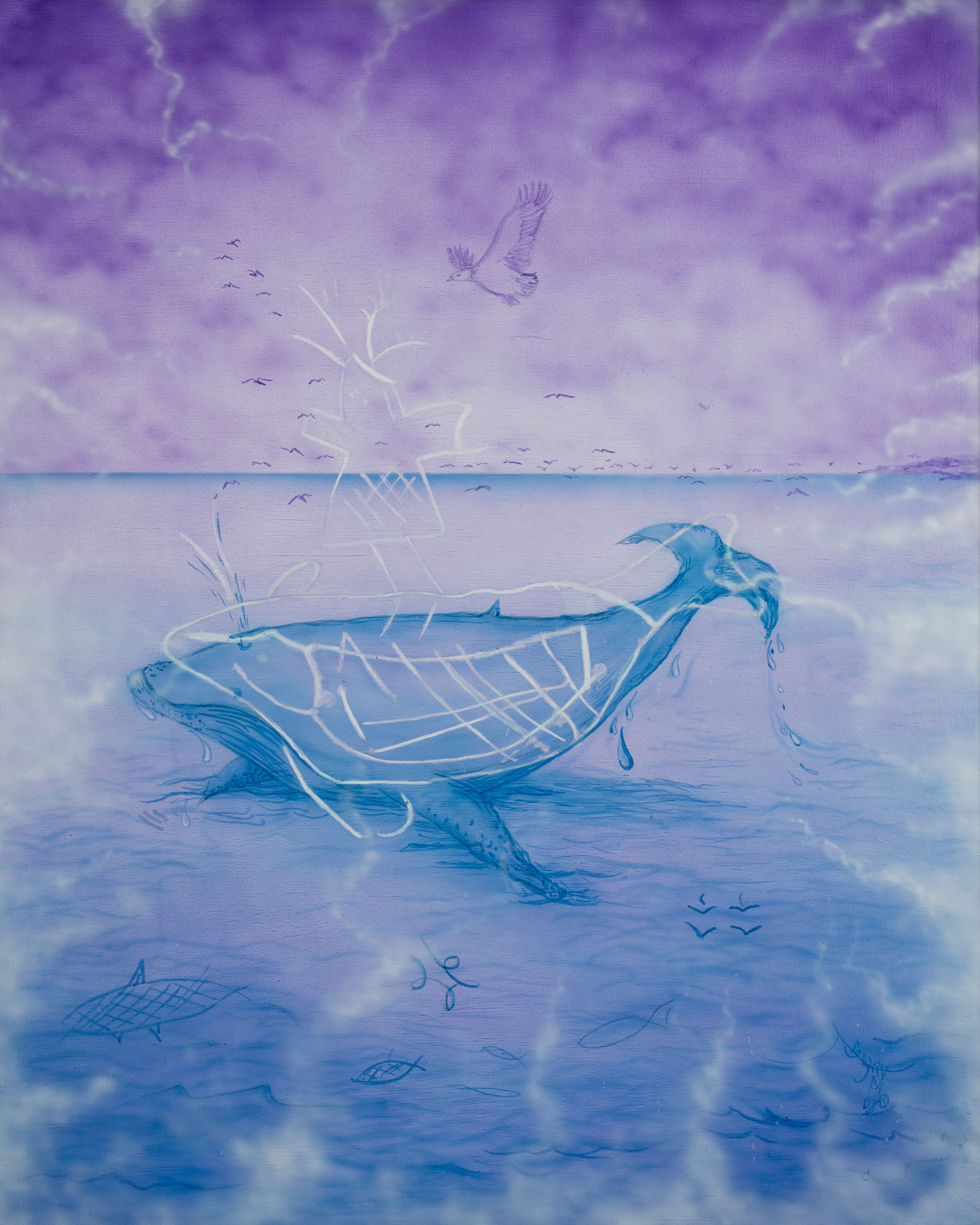
When the time came for Kluskap to leave the Mi’kmaq, it is said that he left on a great whale.
Kluskap is portrayed as creator, protector, father, teacher, and guardian of the Wabanaki peoples. He is shown with his helpers, the dogs Night and Day, and his messenger, the eagle, watching over the land.
It is said that a number of the Wabanaki went to him to wake him to ask for his help when things looked bleak in the first decade of the last century. His help is believed to be possibly forthcoming in the future, to defend the Wabanaki against the white man.
From Dozay:
This series came about over a few years to depict the journeys that Kluskap and the beaver encountered on our beautiful Island. I wanted to research all the legends representing Unama’ki (Cape Breton) landmarks because our Aboriginal history needs to be preserved and used to teach our young and old alike.
I wanted to teach about all the significance of our folklore hero and his many wonderful traits that our Wabanaki culture have followed and believed in for centuries. I also wanted to recognize the original inhabitants, the Mi’kmaw, who are part of the Wabanaki Confederacy
In all of the paintings, the white smoke is the fog; Unama’ki stands for “Land of the Fog.”